

Charging time is one of the most important considerations for any electric vehicle owner. Tesla vehicles offer several charging methods, each with dramatically different speeds.
The time it takes to charge a Tesla depends on four main factors: the charging level you use, battery size, starting battery percentage, and outside temperature. Understanding these factors helps you plan more efficient charging sessions and avoid unnecessary delays.
Charging Methods and How Long They Take
1. Level 1 Charging (120V Outlet) — Slowest
Level 1 charging uses a standard household outlet. It is the slowest method and best for overnight charging when speed is not important.
- Rate: ~2–3 miles of range per hour
- Full charge time: Several days from 0% to 100% (varies by model)
This is typically used only when no faster charging option is available.
2. Level 2 Charging (240V) — Most Common for Homes
Level 2 chargers include the Tesla Wall Connector and third-party home EV chargers. They provide significantly faster charging speeds and are ideal for daily use.
- Rate: 20–44 miles of range per hour
- Full charge time:
- Model 3 / Model Y: ~6–12 hours
- Model S / Model X: ~8–12+ hours
This method is perfect for overnight home charging, ensuring the battery is full every morning.
3. DC Fast Charging — Tesla Superchargers
Tesla’s Supercharger network is the fastest and most convenient way to charge during long trips.
- Rate: Up to 200–300+ miles of range in about 15–30 minutes
- Full charge time:
- 10% to 80%: ~20–30 minutes
- 80% to 100%: Slower due to battery protection
Tesla intentionally slows charging near 80% to preserve battery health, so full charges on Superchargers are usually unnecessary unless you need maximum range.
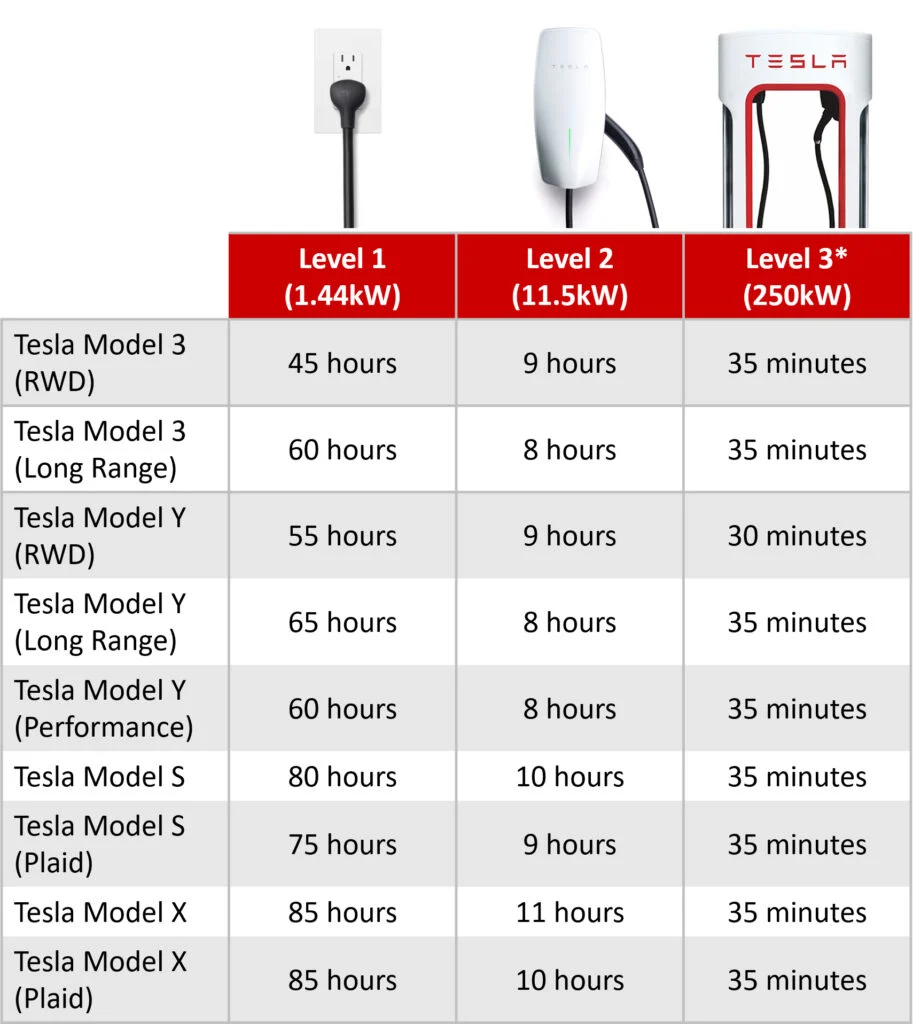
Charging Time by Tesla Model
| Tesla Model | Approx. Battery Size | Level 2 Charge Time (0–100%) | Supercharger Time (10–80%) |
|---|---|---|---|
| Model 3 | 50–82 kWh | 6–10 hours | ~25 minutes |
| Model Y | 75 kWh | 7–12 hours | ~25 minutes |
| Model S | 95–100 kWh | 10–14 hours | ~30 minutes |
| Model X | 95–100 kWh | 10–14 hours | ~30 minutes |
Times vary based on charging speed, temperature, and battery state.
How Fast Can You Charge a Tesla at Home?
Tesla Model | 32 amps / 7.6 kW | 40 amps / 9.6 kW | 48 amps / 11.5 kW |
|---|---|---|---|
| Model S | 30 miles/hr | 37 miles/hr | 44 miles/hr |
| Model 3 | 30 miles/hr | 37 miles/hr | 44 miles/hr |
| Model X | 25 miles/hr | 31 miles/hr | 37 miles/hr |
| Model Y | 29 miles/hr | 36 miles/hr | 42 miles/hr |
| Cybertruck | 20 miles/hr | 25 miles/hr | 30 miles/hr |
Tesla Model | 16 amps / 3.8 kW | 24 amps / 5.8 kW |
|---|---|---|
| Model S | 15 miles/hr | 22 miles/hr |
| Model 3 | 15 miles/hr | 22 miles/hr |
| Model X | 12 miles/hr | 18 miles/hr |
| Model Y | 14 miles/hr | 21 miles/hr |
| Cybertruck | 10 miles/hr | 15 miles/hr |
Factors That Affect Tesla Charging Speed
Battery State of Charge
Charging from 10% to 60% is much faster than charging from 80% to 100%. Tesla slows down charging to protect battery longevity.
Temperature
Lithium-ion batteries prefer moderate temperatures. Cold weather can significantly extend charging time. Tesla preheats their batteries when navigating to a Supercharger to speed things up.
Charger Power Output
A 250 kW V3 Supercharger charges much faster than older 72 kW or 150 kW stations.
Battery Size
Larger batteries take longer to charge, even if the charging speed (kW) is high.
How To Charge a Tesla Faster
- Use Superchargers when traveling — they are the fastest method available.
- Charge between 10% and 80% for optimal speed and battery health.
- Precondition the battery by setting a Supercharger as your navigation destination.
- Install a Level 2 home charger for consistent overnight charging.
- Avoid extremely low temperatures when possible; park indoors to improve charging performance.
FAQ: Tesla Charging Times
1. How Long Does it take to Fully Charge a Tesla at Home?
Using a Level 2 home charger, most Teslas fully charge in 6 to 12 hours.
2. How Long Does it Take to Charge at a Supercharger?
A Tesla typically charges from 10% to 80% in 20–30 minutes at a Supercharger.
3. Can You Charge a Tesla with a Regular Outlet?
Yes. A standard 120V outlet charges very slowly—only 2–3 miles per hour. It’s fine for emergencies, but not ideal for daily use.
4. Why Does Charging Slow Down After 80%?
Tesla slows charging to protect the battery and extend its lifespan. Fast charging is most efficient between 10% and 80%.
5. Does the Tesla Model Affect Charging Time?
Yes. Larger-battery models like the Model S and Model X take longer to charge than the Model 3 and Model Y.
6. Is Supercharging Bad For the Battery?
Occasional Supercharging is fine. However, Tesla recommends using home charging for daily use and reserving Superchargers for longer trips.
7. How Much Does it Cost to Charge a Tesla?
This depends on your local electricity rates. Charging at home is usually cheaper than Supercharging.
8. Can the Weather Affect How Long Charging Takes To Charge?
Yes. Cold weather slows charging because the battery must warm up before accepting higher power.
9. How Long Does it Take to Charge a Tesla From 0 to 100%?
- Level 2 (Home): 6–14 hours
- Supercharger: Tesla rarely recommends charging to 100% unless necessary, but doing so can take 45–75 minutes, because charging slows dramatically above 80%.
10. Should I Always Charge My Tesla to 100%?
No. For daily use, Tesla recommends charging to 80–90%. Charge to 100% only for long trips.