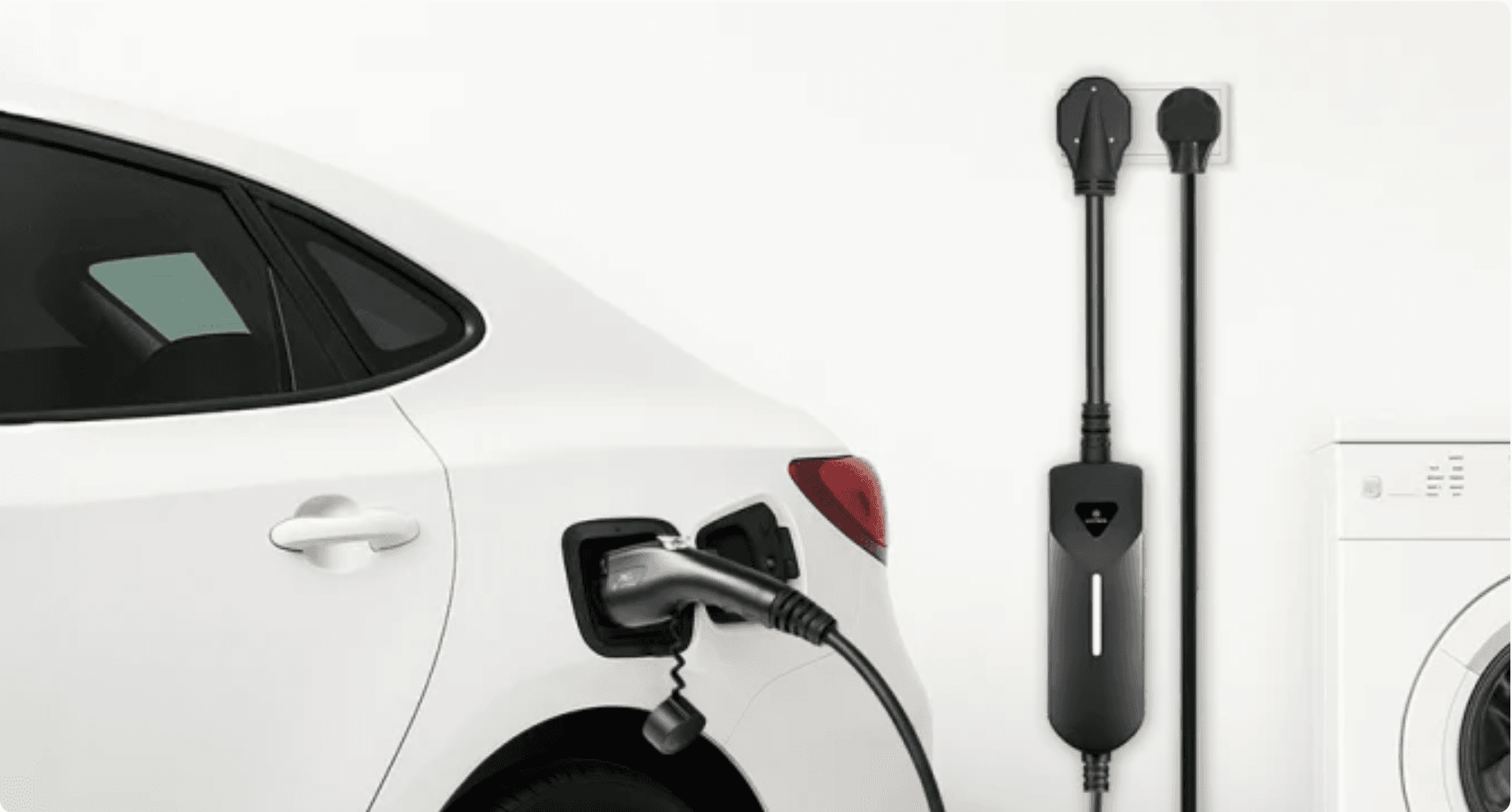
As more drivers switch to electric vehicles, a common question arises: Can you use an existing dryer outlet to charge an EV at home? In many cases, the answer is yes — but with important conditions.
Dryer outlets typically provide 240 volts, the same voltage Level 2 EV chargers use. This makes them an appealing option for faster charging without the cost of installing a new dedicated circuit.
However, safe and effective use depends on the type of outlet, the age of your wiring, and local electrical codes.
Types of Dryer Outlets and Compatibility
Before plugging anything in, identify which outlet type you have:
1. NEMA 10-30 (older, 3-Prong)
- Common in homes built before 1996.
- Lacks a dedicated ground wire.
- Still usable with the correct NEMA 10-30 EV adapter and a charger designed for ungrounded outlets.
- May require a GFCI breaker upgrade to meet modern code.
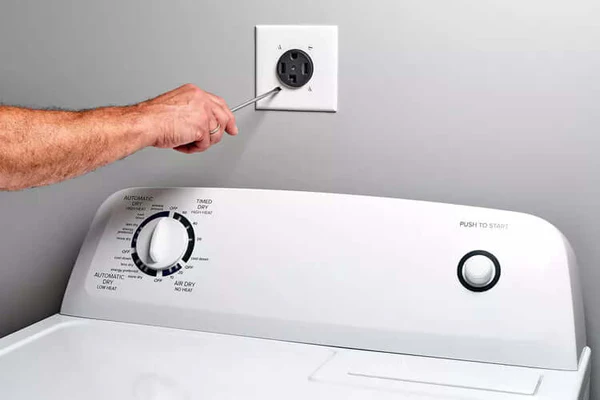
2. NEMA 14-30 (Newer, 4-Prong)
- Includes a dedicated ground.
- Safest and easiest dryer outlet for EV charging.
- Compatible with many Level 2 portable EV chargers using a NEMA 14-30 plug.
3. Usage Limitations
Dryer outlets are typically on a 30-amp circuit, which means:
- You may only draw 24 amps continuously due to the 80% continuous-load rule.
- Most portable chargers that plug into these outlets are limited to 16–24 amps (3.8 kW to 5.7 kW charging speed).
This is faster than Level 1 charging and provides 12–25 miles of range per hour, depending on the vehicle.
Benefits of Using a Dryer Outlet for EV Charging
1. Lower Installation Cost
You may not need to hire an electrician for a full new circuit, saving hundreds of dollars.
2. Faster than Level 1 (120V) charging
Level 2 charging from a dryer outlet is 3–5x faster.
3. Convenient for garages with existing dryer hookups
Many homeowners find this an ideal temporary or permanent solution.
Risks and Considerations
1. Do not use the Dryer Outlet and Charger at the Same Time
Both appliances share the circuit. Plugging both in simultaneously can:
- Trip breakers
- Overheat wiring
- Create fire hazards
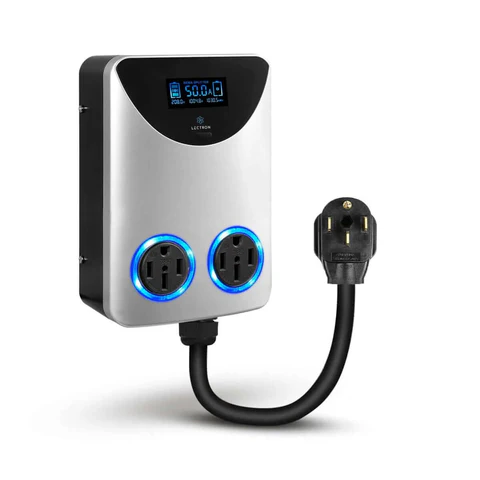
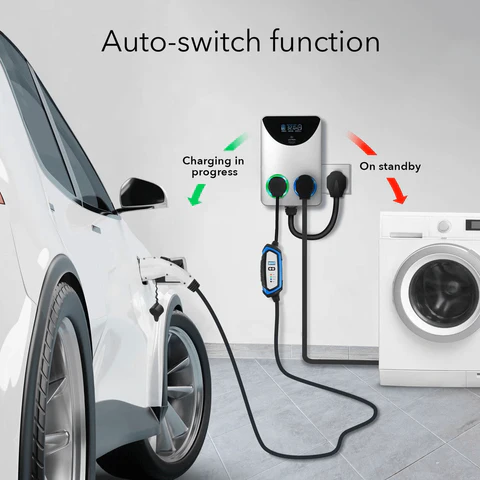
If your home requires both devices regularly, consider a smart splitter, which switches power between the dryer and EV automatically and safely.
2. Wiring Condition Matters
Older homes may have:
- Aluminum wiring
- Loose connections
- Undersized conductors
An electrician can evaluate safety.
3. Adapters can be Dangerous if misused
Only buy UL-listed charging equipment and never use generic “dumb” adapters without built-in safety features.
4. Local Electrical Codes May Restrict Usage
Some regions require dedicated circuits for EV charging. Always check with a licensed electrician.
When Should You Install a Dedicated EV Circuit Instead?
A new Level 2 EV charging circuit is better if:
- You need a faster charging (40–48 amp charger).
- You want the ability to charge and use your dryer simultaneously.
- Your dryer outlet is in a location inconvenient for charging.
- Your existing wiring is outdated.
A dedicated circuit also supports future EVs with larger batteries.
Best Practices For Charging an EV From a Dryer Outlet
- Use a UL-listed portable Level 2 charger compatible with 30-amp circuits.
- Label the breaker, so others know the outlet is shared with an EV.
- Avoid extension cords.
- Periodically check the plug for heat buildup.
- If the outlet feels loose or worn, replace it immediately.

FAQ: Charging an EV with a Dryer Outlet
1. Is it safe to charge an EV using my dryer outlet?
Yes, if the outlet and wiring are in good condition, you use proper equipment, and you do not exceed 80% of the circuit’s capacity.
2. Will charging from a dryer outlet damage my EV battery?
No. The EV’s onboard charging system controls voltage and current. Charging from a 240V dryer outlet is well within safe operating limits.
3. How fast will my EV charge using a dryer outlet?
Most 30-amp dryer outlets deliver 3.8–5.7 kW, giving around 12–25 miles of range per hour.
4. Can I Use a Simple Outlet Adapter?
Not recommended unless it is a purpose-built EV charging adapter with safety features. Avoid any adapter that simply changes plug shape without electrical protection.
5. What if My Dryer Outlet is Too Far From My Car?
Do not use an extension cord. Hire an electrician to:
- Move the outlet.
- Install a new EV circuit.
- Install a smart splitter.
6. Can I Charge and Run My Dryer Simultaneously?
No. They share the same 30-amp circuit. Using both at once is unsafe unless you install a smart switching device.
7. Do all EV Chargers Support Dryer Outlet Plugs?
No. Many chargers come with a standard 120V plug or require hardwiring. You’ll need a portable Level 2 charger with 10-30 or 14-30 support.
8. Do I need a Permit to use my Dryer Outlet For EV Charging?
Usually not, but modifications — such as adding a smart splitter or replacing wiring — may require a permit depending on local codes.
9. Will using the Dryer Outlet Void my EV Warranty?
No. Automakers support Level 2 charging from any properly wired 240V source.
10. Is a Dedicated EV Charger Better in the Long Run?
Often yes. A dedicated circuit provides:
- Faster charging
- Greater convenience
- Support for future EVs
- Improved safety
But for many homeowners, a dryer outlet is a cost-effective and practical alternative.